


Master in Materials Science
Department of Physics, Faculty of Mathematics and Natural Sciences, University of Indonesia

Description
The Master’s Program in Materials Science at Universitas Indonesia is a research-based graduate program offered by the Faculty of Mathematics and Natural Sciences, one of the leading centers for science education and research in Indonesia. The program is designed to produce graduates with an advanced understanding of the relationships between the structure, properties, processing, and performance of materials—covering metals, ceramics, polymers, composites, magnetic materials, electronic materials, and nanomaterials—as well as the ability to critically evaluate recent developments in materials science and technology that are relevant to industrial needs and national development. The curriculum integrates a strong theoretical foundation with intensive laboratory research, enabling students not only to master the underlying concepts but also to develop practical skills in designing, synthesizing, characterizing, and evaluating materials for a wide range of applications, including energy, manufacturing, health, and environment.
The curriculum is aligned with the Indonesian National Qualifications Framework (KKNI) Level 8 for master’s programs and with the learning outcomes recommended by the Physical Society of Indonesia (PSI), ensuring that graduates’ competencies are consistent with national standards and with expectations of the broader scientific community in physics and materials science. The quality of the program is further evidenced by international accreditation from ASIIN in the field of Physical Technologies, Materials and Processes, and an “Excellent” national accreditation rating from LAMSAMA, confirming that the education and research conducted in this program meet high-quality standards recognized at both national and international levels.
Objectives
- To produce Master of Materials Science graduates who are capable of critically evaluating the latest developments in materials science and technology.
- To produce Master of Materials Science graduates who are capable of identifying and analyzing problems in the field of materials science, as well as formulating scientifically responsible solutions through a multidisciplinary approach that benefits humanity.
- To produce Master of Materials Science graduates who are capable of managing, leading, and developing experimental research methods and/or materials modeling with due regard to ethics, safety, environmental, and socioeconomic aspects.
Strategy
To achieve its objectives, the Master of Materials Science Program is guided by six core strategies:
- Advancing Curriculum and Academic Excellence by continuously enhancing the curriculum to reflect emerging developments in materials science, technology, and industry needs.
- Fostering a Research-Oriented Learning Environment by providing students with opportunities to engage in experimental and computational research supported by state-of-the-art facilities and advanced analytical tools.
- Promoting Multidisciplinary Collaboration by encouraging collaboration across disciplines and with leading research institutions to address complex scientific and technological challenges.
- Upholding Ethics and Responsible Research by integrating research integrity, safety, environmental stewardship, and socioeconomic considerations throughout academic and research activities.
- Strengthening Industry and Societal Engagement by establishing strategic partnerships with industry, government, and research organizations to enhance the relevance and impact of student learning and research.
- Developing Future Researchers and Innovators by cultivating critical thinking, leadership, and problem-solving skills that enable graduates to contribute effectively to academia, industry, and society.
Graduate Profile
Graduates of the Master’s Program in Materials Science at Universitas Indonesia are early-career professionals and researchers who understand the interrelationships between the structure, properties, processing, and performance of a wide range of materials, and who can critically assess recent developments in materials science and technology. They are trained to design and conduct experimental and modeling-based studies with a strong commitment to academic integrity, to analyze data rigorously, and to formulate scientifically sound conclusions.
When confronted with real-world, materials-related challenges, graduates are able to identify problems, formulate logical and data-driven solutions, and take into account safety, environmental considerations, and socio-economic impacts. They are capable of designing new materials, processing routes, and innovative characterization or analysis techniques that support industrial development and provide tangible benefits to society.
Graduates are also prepared to work effectively in multidisciplinary teams, to collaborate and communicate across national and international contexts, and to contribute within academic institutions, research organizations, and industrial settings. With this profile, alumni of the Master’s Program in Materials Science at UI are expected to pursue careers as scientists, lecturers, researchers, entrepreneurs, or industry professionals who are critical, creative, and adaptive to technological change.
Program Learning Outcome (PLO)
- Demonstrate an integrated understanding of the structure, properties, processing, and performance of material systems, and critically evaluate recent developments in materials science and technology. (Sub 1, Sub 3, Sub 6)
- Design and conduct experimental research and mathematical modeling in accordance with academic and research ethics, critically and systematically analyze data, and draw scientifically sound conclusions.
- Identify and analyze problems in materials science and formulate scientifically sound solutions while considering ethical, environmental, and socio-economic aspects.
- Design and develop new materials, processing methods, material characterization and analysis techniques, and innovative material products, while incorporating humanistic values to contribute to the advancement of materials science, industry, and society.
- Apply materials science concepts to solve complex problems in industrial materials applications through a multidisciplinary approach that considers safety, social, and ethical aspects.
Admission Information
The entire application process is conducted online through a centralized portal on the official website: penerimaan.ui.ac.id.
Universitas Indonesia (UI) opens postgraduate admissions two to three times a year:
- Odd Semester Intake: Batch 1 (February–March) and Batch 2 (May–June).
- Even Semester Intake: Batch 3 (October–November).
Admission Requirements for the Master’s Program in Materials Science through SIMAK UI
- Educational Background: Applicants must hold a bachelor’s degree in a related field, such as Physics, Chemistry, Materials Engineering, Chemical Engineering, Mechanical Engineering, or other relevant science and engineering disciplines.
- Minimum GPA Requirement:
- Minimum GPA of 2.75 on a 4.00 scale for graduates of public or private universities with an Unggul (Excellent) accreditation rating.
- Minimum GPA of 3.00 on a 4.00 scale for graduates of institutions with other accreditation ratings.
- Supporting Documents: Bachelor’s degree certificate, certified academic transcript, and letter(s) of recommendation, typically from an undergraduate academic supervisor or employer.
- Pass the SIMAK UI admission selection.
- Coursework–Research Track: Applicants may be required to undertake a matriculation program if additional academic preparation or subject equivalency is considered necessary.
- Research Track: Further information on the Research Track is available at www.sci.ui.ac.id. Applicants must:
a. Have prior research experience, demonstrated by authorship or co-authorship of a scientific article published in a national or international publication.
b. Pass an interview on the proposed research plan, conducted after the SIMAK examination.
c. Applicants who do not meet requirements (a) and (b) will be advised to pursue the Coursework–Research Track. - Class Arrangements:
a. Regular Classes: Monday–Friday at the UI Depok Campus.
b. Non-Regular Classes: Schedules are arranged by the study program.
Scholar Opportunities
Major Government Scholarships (Fully Funded)
LPDP Scholarship
LPDP (Lembaga Pengelola Dana Pendidikan / Indonesia Endowment Fund for Education)
- Coverage: Comprehensive funding that may include full tuition fees, monthly living allowance, book allowance, thesis/dissertation research funding, international seminar support, and emergency funding.
- Priority Areas: STEM (Science, Technology, Engineering, and Mathematics) fields—particularly advanced materials, manufacturing, and renewable energy—are among the areas prioritized in support of Indonesia’s national development.
BPI Scholarship
BPI (Beasiswa Pendidikan Indonesia / Indonesian Education Scholarship)
- Coverage: Similar in scope to LPDP and administered by the Ministry responsible for education.
- Categories: Specific schemes are available for prospective lecturers and educators, cultural practitioners, and high-achieving bachelor’s or master’s graduates who wish to continue their studies in a related field.
Accelerated and Research-Specific Scholarship Schemes PMDSU
PMDSU (Pendidikan Magister menuju Doktor untuk Sarjana Unggul / Master’s-to-Doctoral Education for Outstanding Graduates)
- Scheme: A fast-track program designed primarily for outstanding recent bachelor’s graduates, enabling participants to pursue integrated Master’s and Doctoral studies and complete the program within approximately four years.
- Advantages: The program is fully funded, and students conduct their research under the direct supervision of an eligible professor or doctoral-level principal investigator at UI with a strong international research track record. Research topics in areas such as nanomaterials, energy-conversion materials, and polymers are highly relevant to research activities within FMIPA and FT UI.
Degree by Research (DBR) – BRIN Collaboration
- Scheme: UI provides research-based postgraduate study opportunities in collaboration with the National Research and Innovation Agency (BRIN).
UI Internal Scholarships and Research Grants
UI Endowment Fund and Industry Partners
UI periodically offers scholarships supported by corporate and philanthropic partners, such as Hana Bank, Low Tuck Kwong–Purnomo Yusgiantoro Center, Jardine Cycle & Carriage, and other donors. Scholarship opportunities are generally announced through the centralized UI scholarship portal at beasiswa.ui.ac.id after the applicant has officially enrolled as a UI student.
Research Assistant (RA) Opportunities through Faculty Research Grants
Many faculty members and research groups within the Department of Physics, FMIPA UI, manage research projects funded through UI internal grants or national competitive research funding. Depending on project availability, postgraduate students may have opportunities to participate as Research Assistants (RAs) and receive research-related financial support.
The Master’s Program in Materials Science is organized into two terms (semesters) per academic year, where one period typically spans 16 weeks of educational activities. To weigh the load of courses offered in a period, UI employs a credit unit system known as “SKS.” One SKS is equivalent to a 1-hour (50-minute) lecture followed by 60 minutes of structured learning activity (e.g., assignments) and 60 minutes of independent learning activity per week.
By Course
The Master’s Program in Materials Science is organized into two terms (semesters) per academic year, where one period typically spans 16 weeks of educational activities. The current curriculum of MPMat is constructed using the OBE a by-course programme. The curriculum was created to yield professionals or experts in academia/research, industry, and other multinational companies. The graduate from this track can learn and adapt quickly to the industrial work environment and solve problems in their work area by applying materials science and scientific thinking. The modules are designed to ensure students achieve the intended competencies, categorized as compulsory and elective modules, especially for the by-course programme. During the 1st and 2nd semesters, the student takes compulsory and elective modules on a fundamental concept of materials science and its application for doing research in 3rd and 4th semesters.
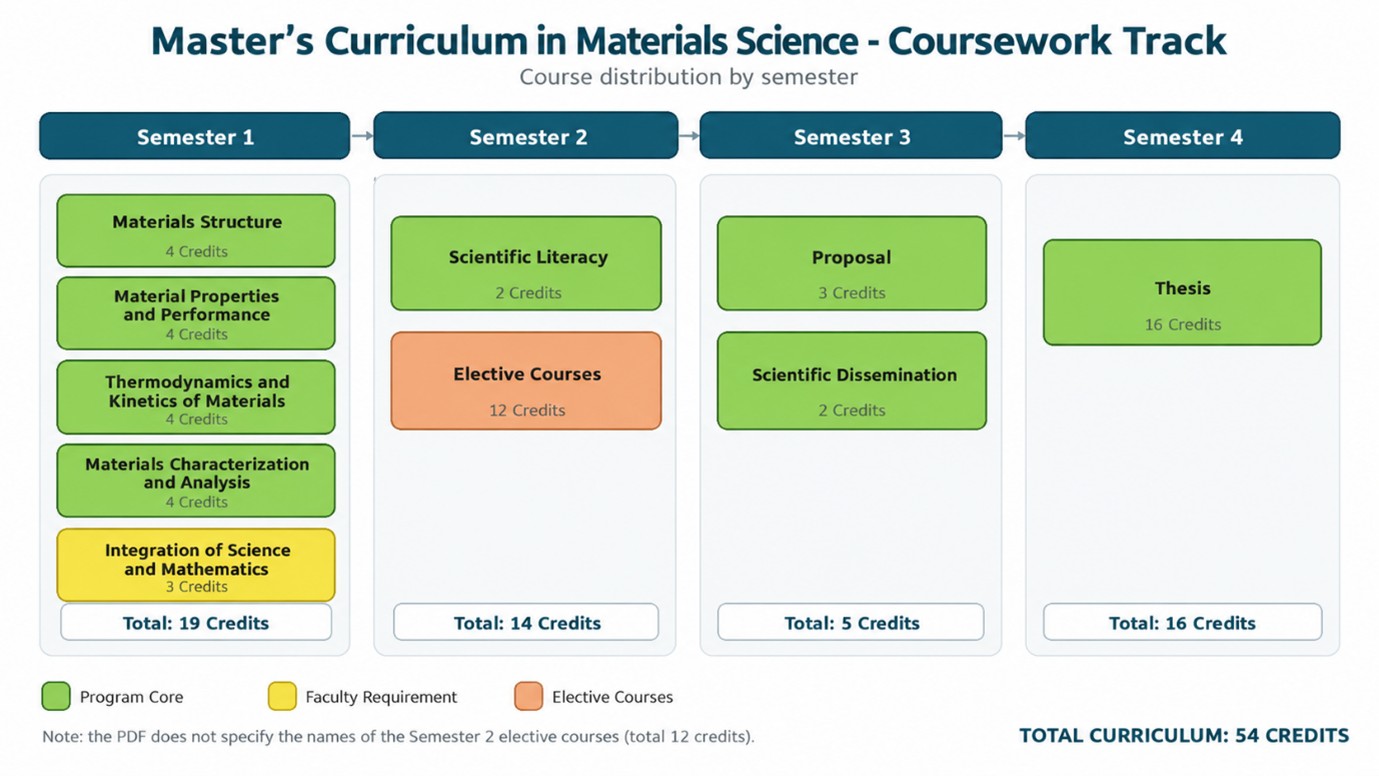
The curriculum was created to yield professionals or experts in academia/research, industry, and other multinational companies. The graduate from this track can learn and adapt quickly to the industrial work environment and solve problems in their work area by applying materials science and scientific thinking. The modules are designed to ensure students achieve the intended competencies, categorized as compulsory and elective modules, especially for the by-course programme. During the 1st and 2nd semesters, the student takes compulsory and elective modules on a fundamental concept of materials science and its application for doing research in 3rd and 4th semesters.The compulsory modules in the 1st semester (Structure Material, Material Properties and Performance, Thermodynamic and Material Kinetic and Characterization and Materials Analysis) are provided to enhance the student’s basic knowledge of materials science. In the 3rd semester, students could attend an international forum and publish their articles in proceedings indexed by Scopus. The student can also publish their paper in the national journal with Sinta rank minimal 2. The article can be produced as a part of their research or work in collaboration with the lecturer. In the 4th semester, the student performs a complete research methodology starting from literature review, proposal, experiment, and writing.

By Research
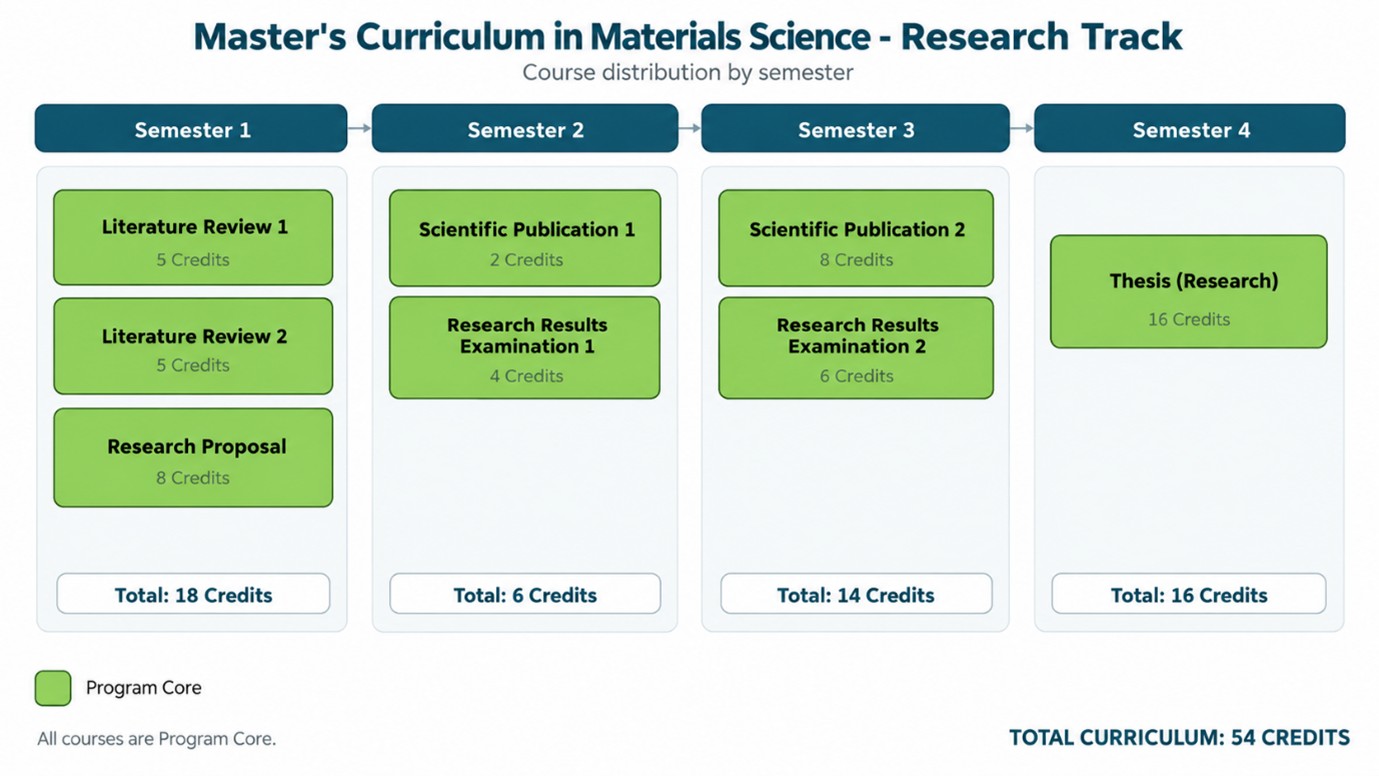
The curriculum structure of By-Research Programme consists of seven (7) modules: Literature Review 1 and 2, Research Proposal, Progress Results, Scientific Publication 1 and 2, and Thesis. Curriculum structure of By-Research was designed to accommodate a robust basic competency for performing research in corresponding subject. This programme facilitates researchers from research institutes to be able to create and carry out research in their field and its applications.

Regulations
- Rector Decree No. 25/2022 – Implementation of the Master Program
- Rector Decree 1282/2020 – Curriculum of the Master Programme in Materials Science
- Rector Decree No. 2/2021 – Implementation of the Master Programme in Material Science
- Rector Decree No. 015/2016 – Implementation of the Masters Program at the Universitas Indonesia
- Rector Decree No. 2143/2017 – Technical Guidelines for Thesis Writing
- Dean Decree No. 133/2015 – Thesis Completion Guidelines
Guidelines
- Academic Guidelines for the Master Study Program
- Handbook S2 Ilmu Material
- Structured S2 & S3 Course Implementation Report Templates
- Unstructured S2 & S3 Course Implementation Report Templates
- Petunjuk Teknis Sidang Online S2 Ilmu Material
- Borang Penilaian Publikasi Ilmiah 2021
- SCPH802806 – S2 Kuliah – Publikasi Ilmiah
- SCPH801006 – S2 Riset – Publikasi Ilmiah 2
- SCPH801004 – S2 Riset – Publikasi Ilmiah 1
- SCPH801007 – S2 – Thesis
- Pedoman Penyelesaian Tesis Ilmu Material 2019
- Rubrik Penilaian Ujian S2 Ilmu Material 2019
